
Muscle coverage
Did the split reach chest, back, shoulders, arms, glutes, quads, hamstrings, calves, and trunk work in a way that matches your goal?
Analyze Your Split
Audit Recent Training
A split name does not prove your training is balanced. Your recent lifts do.
Your split is the plan. Your logged work is the evidence. Via Fortis helps you check whether your push, pull, legs, upper/lower, or full-body split actually covered the muscles and movement patterns you meant to train.
Direct Answer
Most lifters describe their plan by split: push pull legs, upper/lower, full body, bro split, or something custom. That is useful shorthand, but it can hide what changed once real life, exercise swaps, and missed sessions got involved.
A useful split analysis asks what your recent training actually covered: which muscles were trained, which movement pillars showed up, and which areas were light or missing.
What To Check
The question is not only whether you had a push day or a leg day. It is whether the logged lifts created the training pattern you intended.
Did the split reach chest, back, shoulders, arms, glutes, quads, hamstrings, calves, and trunk work in a way that matches your goal?
Did push, pull, squat, hinge, and core work all show up, or did your split quietly become press-heavy or quad-heavy?
Are the same areas light because of one unusual week, or because the split is not giving them a reliable place?
PPL is not automatically balanced. If leg days become mostly squat patterns, or push volume keeps expanding, hinge and core work can fall behind even when the split looks complete.
An upper day can include plenty of pressing and rows while still giving rear delts, side delts, or arms less direct work than you intended.
Example Split Audit
A split can look balanced by name while the logged work tells a different story.
Push, pull, legs across the week, with enough sessions to cover upper body and lower body work.
Push is strong, squat work is covered, hinge is light, core is missing, and rear delts are mostly indirect.
Add a reliable hinge slot, make core intentional, and check whether pull days include enough upper-back and rear-delt work.
Via Fortis Training Audit
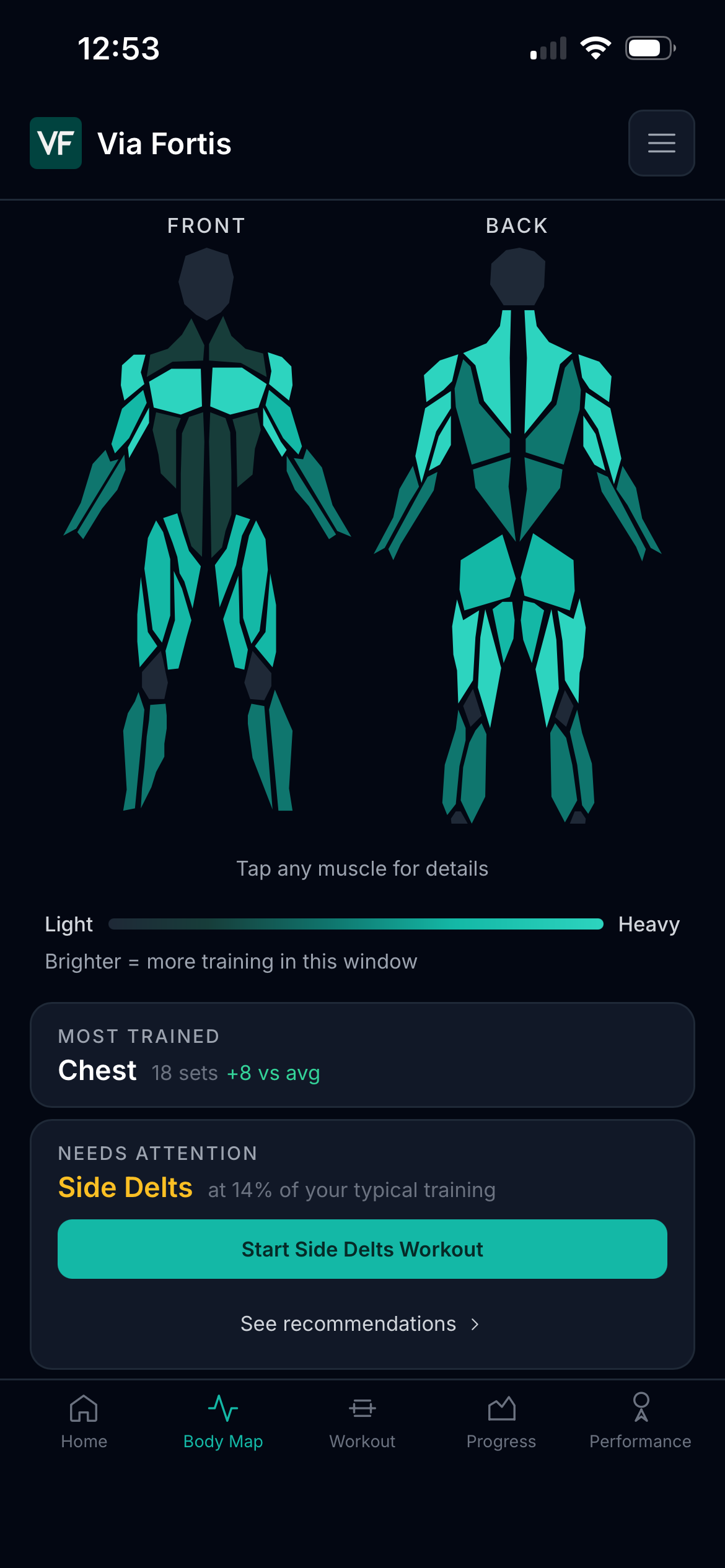
The free audit maps your entered lifts into muscle coverage and movement balance, then highlights the areas that may need review.
That is different from a calendar or spreadsheet check: it starts from the lifts you actually logged, then shows what those lifts trained.
That gives you a practical answer before you rewrite the whole split: what is covered, what is overrepresented, and what might need a more reliable slot.
Common Split Reviews
The split is the starting point. The logged work is the evidence.
Check whether legs include both squat and hinge work, whether pull days include upper back and rear delts, and whether core has a clear place.
Check whether each session is truly broad, or whether the same few lifts are repeating while smaller muscle groups stay quiet.
A travel week, deload, or missed session can distort the snapshot. The point is to see the shape clearly, then decide whether it was intentional or accidental.
Via Fortis keeps Body Map, Weekly Balance, and Lift Progress updated as you log, so you can tell whether a split issue is temporary or recurring.
FAQ
Compare the split name against recent logged work. Check which muscles were covered, whether push, pull, squat, hinge, and core work showed up, and which areas were missed or repeated too often.
Yes. The Via Fortis Training Audit lets you enter your current program, a typical training week, or your recent workouts in your browser and previews muscle coverage, movement balance, and training gaps from the lifts you enter.
Not automatically. A push pull legs split can still drift if sessions are missed, exercise choices are skewed, or hinge, core, calves, rear delts, or upper back work does not show up consistently.
Not always. One short window can be noisy. The goal is to see whether the gap is intentional, temporary, or part of a pattern that should be adjusted.
Run a private browser audit to check muscle coverage, movement balance, and training gaps from your recent lifts.