

Why normal logs miss it
Most logs are built around entries: exercise, weight, reps, sets, notes. That is useful in the moment, but it can hide the body-level pattern underneath.
Learn: Muscle Coverage
Body Map Basics
Muscle coverage shows which muscles your workouts actually trained over time.
A normal gym log tells you what exercises you did. Muscle coverage connects those exercises to the primary and supporting muscles they touched, so missed areas and repeated patterns are easier to see.
Definition
If you log bench press, rows, split squats, curls, and hinges, the exercise list alone only tells part of the story. Muscle coverage asks a different question: which muscles did that work actually reach?
A useful coverage view should account for primary and supporting work. A row may train lats directly while also touching upper back, rear delts, and biceps. A squat may emphasize quads while also involving glutes, adductors, and trunk demands. Good tracking makes those relationships easier to review instead of forcing you to rebuild them from memory.
Most logs are built around entries: exercise, weight, reps, sets, notes. That is useful in the moment, but it can hide the body-level pattern underneath.
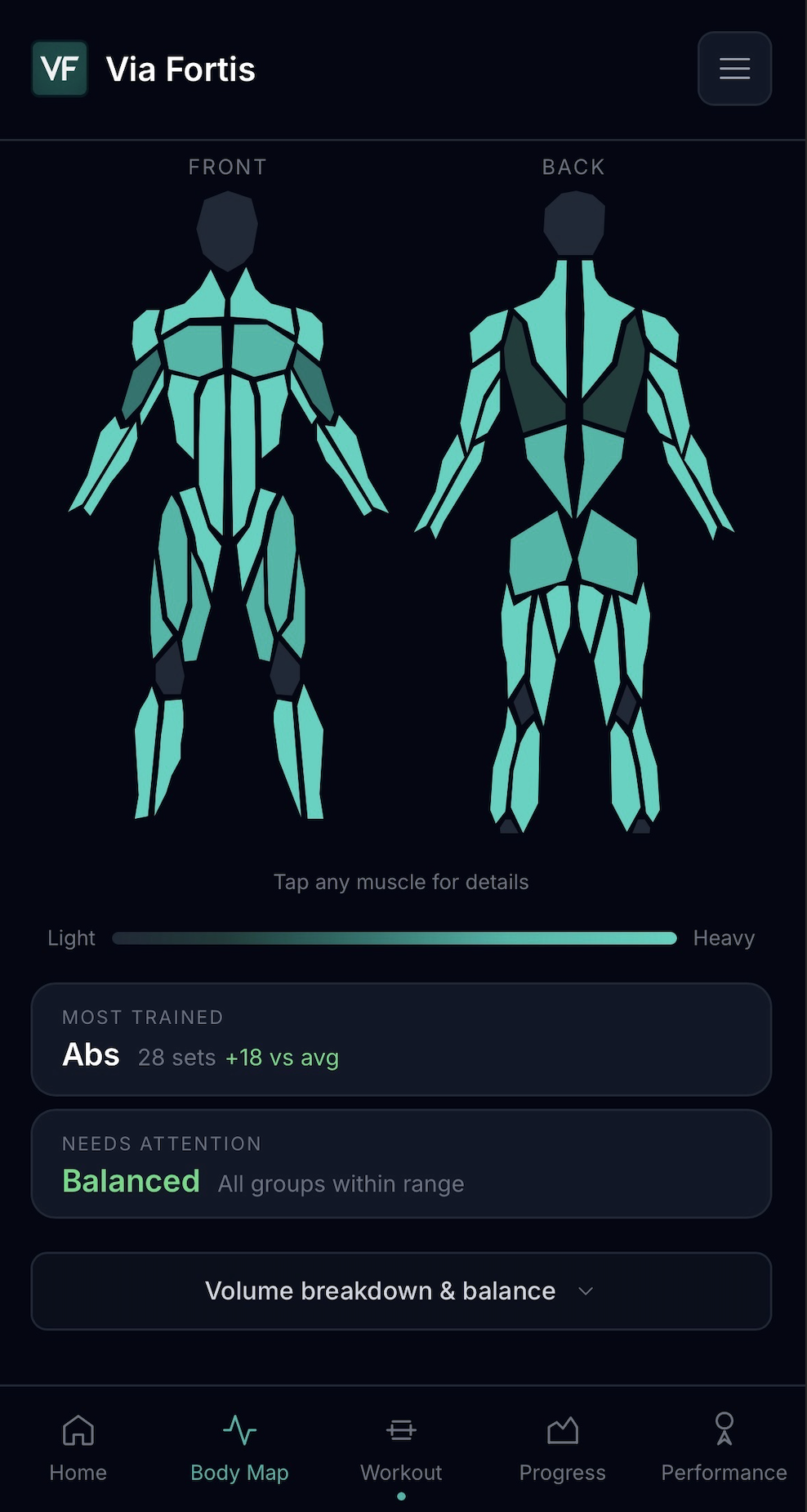
In Via Fortis, Body Map is the workout body map and muscle heat map view that makes coverage visible. Brighter areas show more mapped work. Dimmer or quiet areas show places that may need review.
If you are choosing between tools, see how the best muscle heat map apps differ on time windows and baselines.
Via Fortis Body Map
Via Fortis maps 120+ exercises to primary and supporting muscles. Body Map then turns your workout history into a visual workout body map, or muscle heat map, across different time windows.
That gives you a clearer read on what your training is becoming: what is showing up often, what is lightly touched, and what may be missing.
How to Read It
A short window can show what you missed recently. A longer window can show whether the same gaps keep appearing.
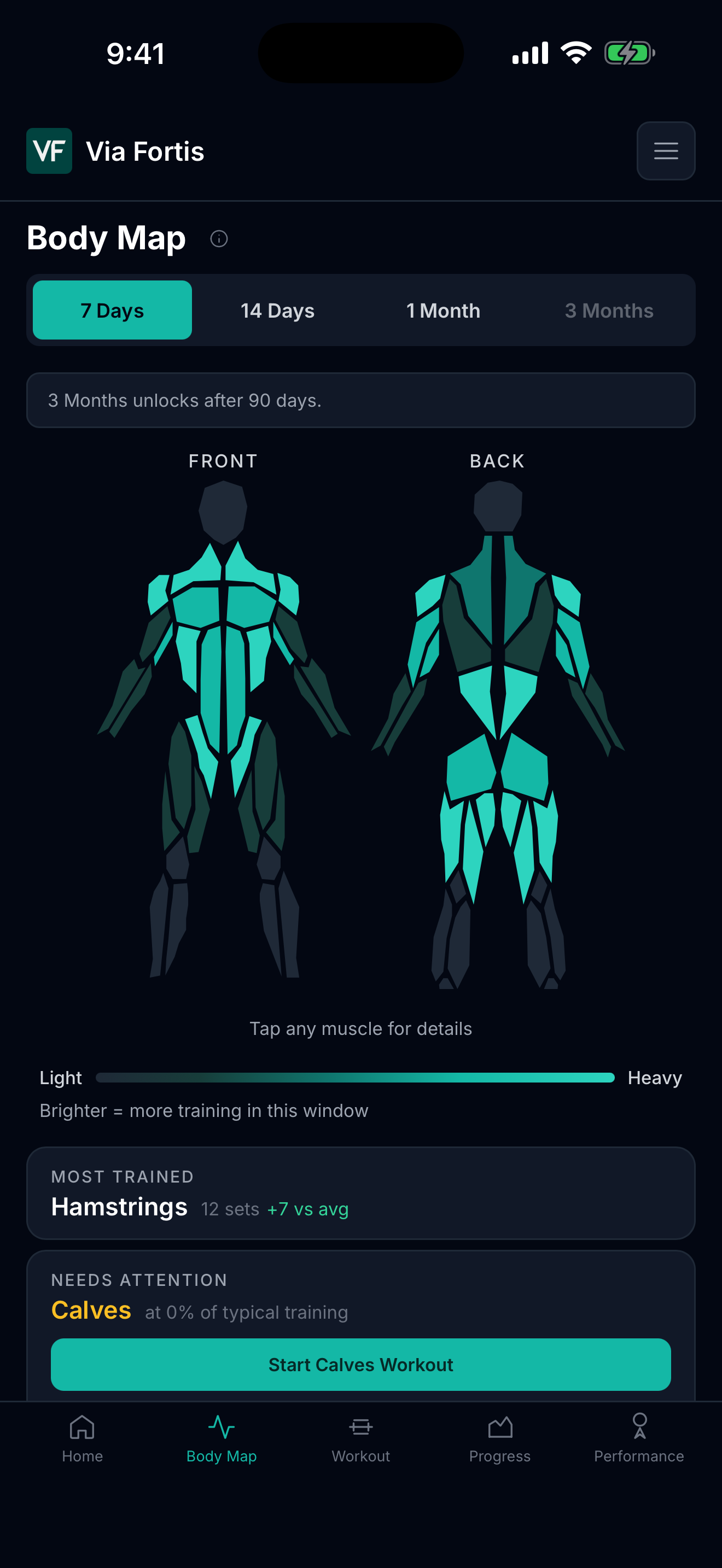
7 Days
In a short window, a muscle can stay quiet even when the week feels busy. That is useful when you want a fast check on what your last few sessions actually covered.
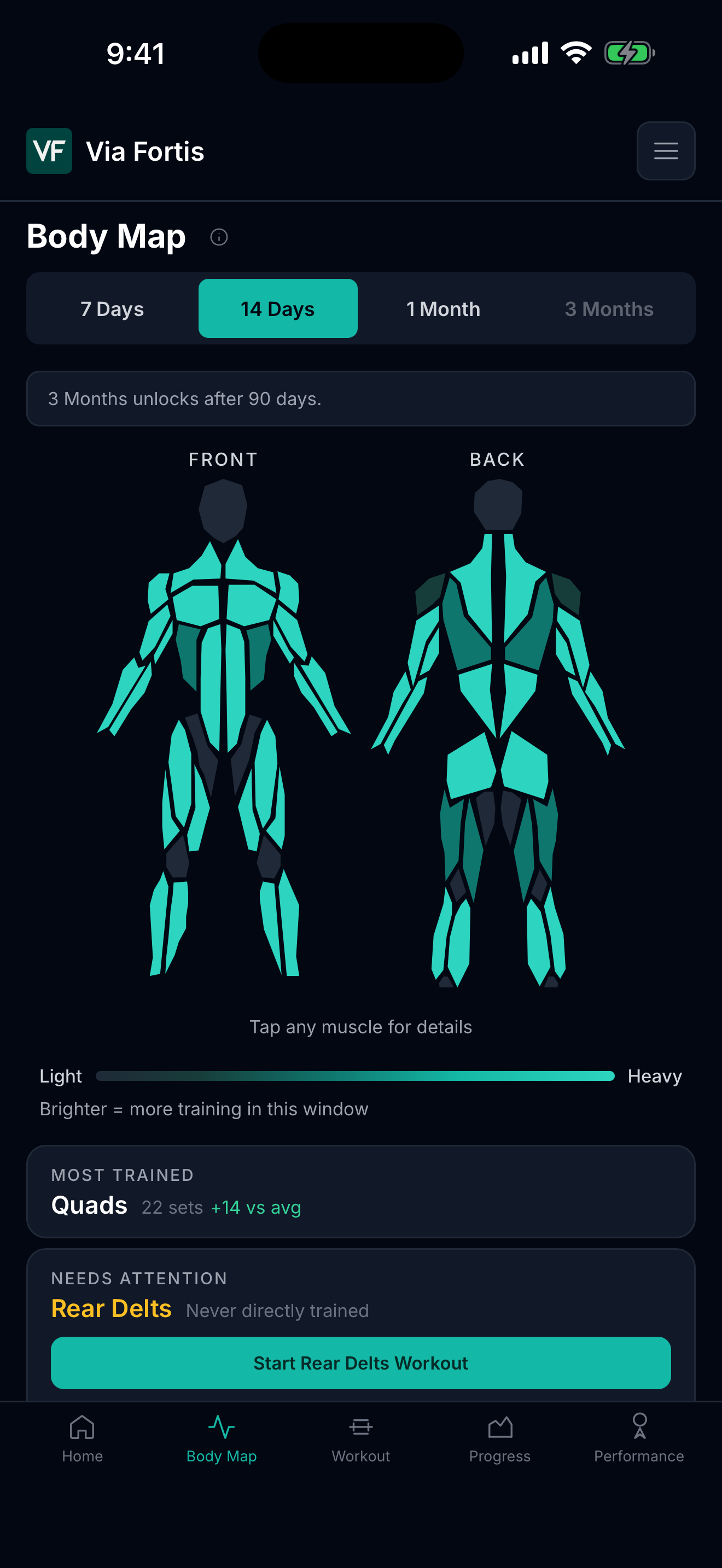
14 Days
A muscle may get indirect activity from compound lifts and still be undertrained directly. That distinction is where coverage gets more useful than a plain exercise list.
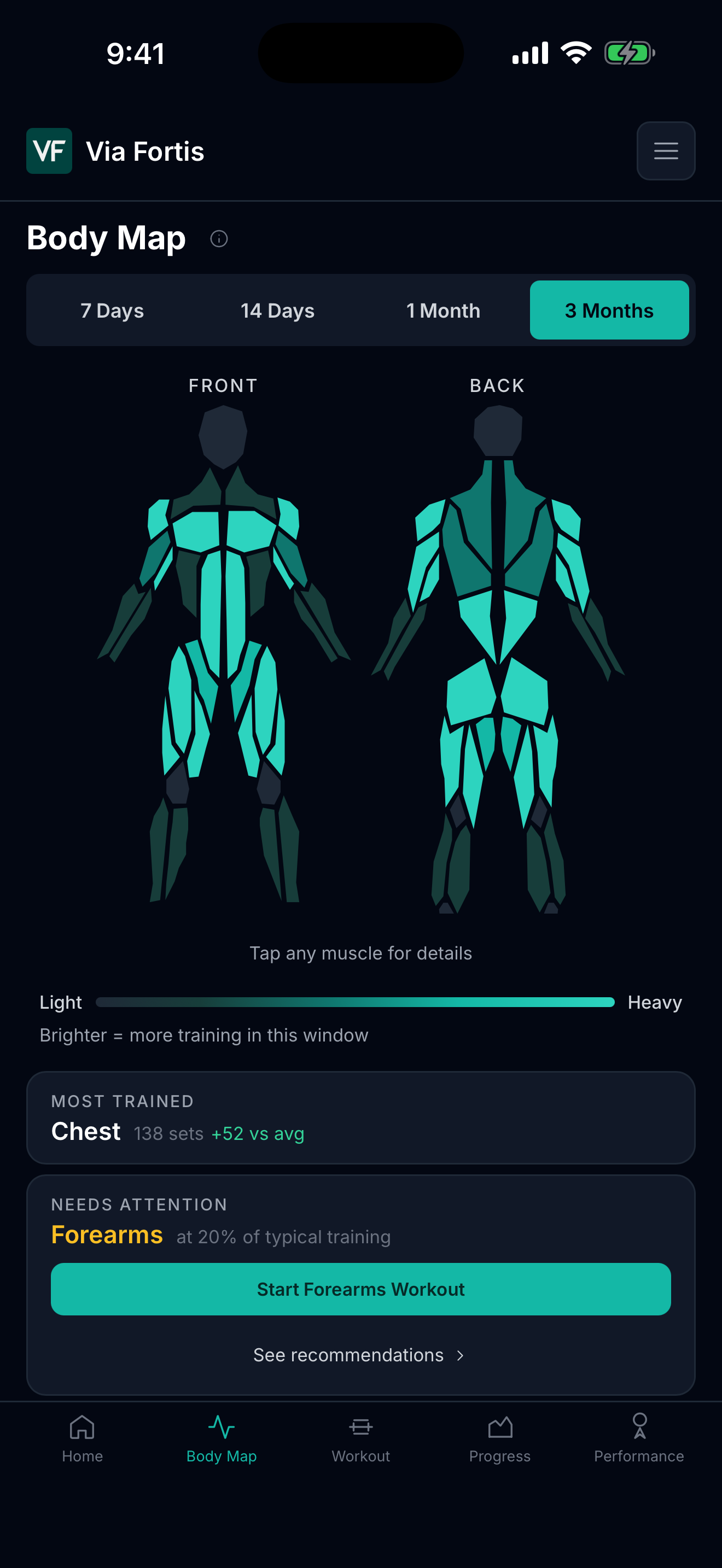
3 Months
If an area stays dim over months, it is easier to tell whether it was a one-week miss or a real pattern in the way you train.
Your training does not need every muscle to look identical every week. The goal is to see whether the pattern matches your intent.
A single week can be noisy. Coverage becomes more useful when you can review short windows and longer patterns together.
FAQ
No. Hypertrophy-focused lifters may care about sets per muscle, but strength-focused lifters can use coverage to understand whether their program is leaving support muscles or movement patterns behind.
No. Muscle coverage shows mapped training work, not recovery status. It helps you review what you trained, then make your own programming decision.
Yes. The free training audit lets you enter your current program, a typical training week, or recent workouts in your browser and preview how Via Fortis turns lifts into coverage.
Download Via Fortis on iPhone, or try the free audit first to preview muscle coverage from your current program, typical training week, or recent workouts.